By Jame, Product Manager, Mapper Footwear — Jieyang, Guangdong | mappershoe.com
Last updated: July 2026
Regulatory requirements change frequently. All information in this article was verified as of July 2026. Always confirm current requirements with your customs broker or legal counsel before importing.
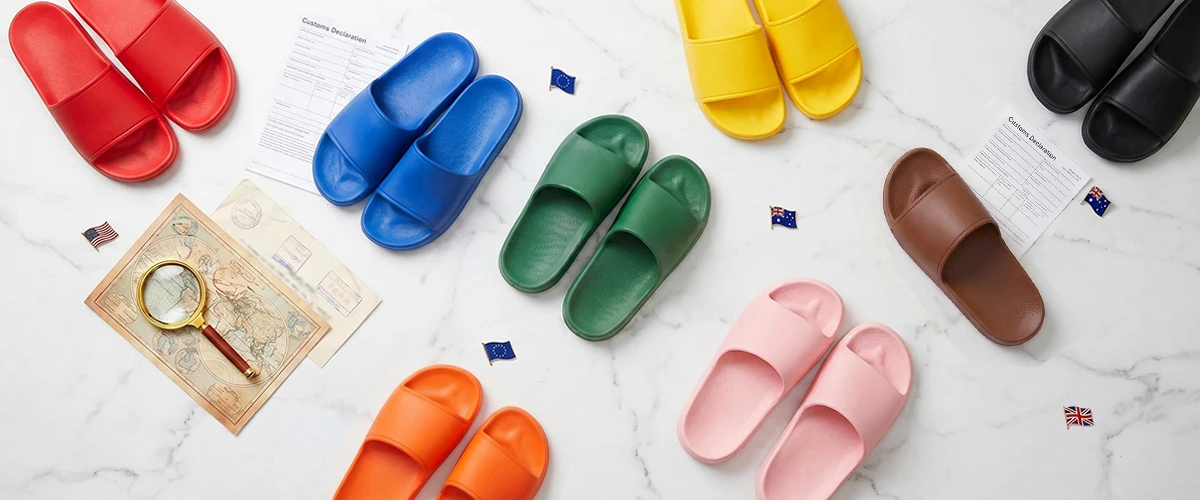
Here is the short answer: slipper import certifications depend entirely on where you are selling, not just where the slippers are made. A factory that exports to the US, EU, and UK simultaneously is managing three different compliance frameworks — and none of them fully overlap.
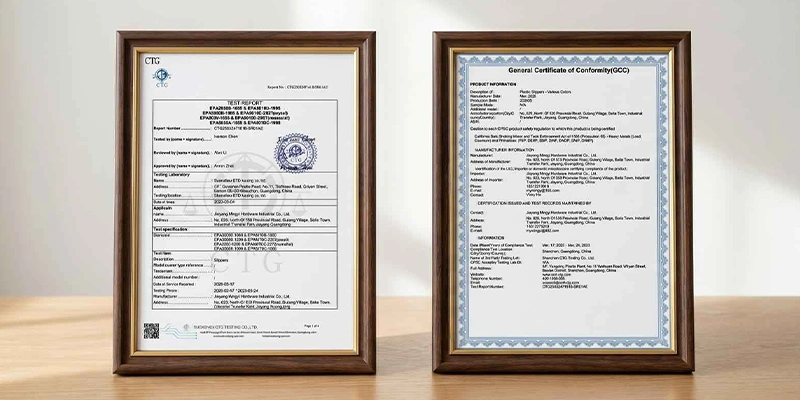
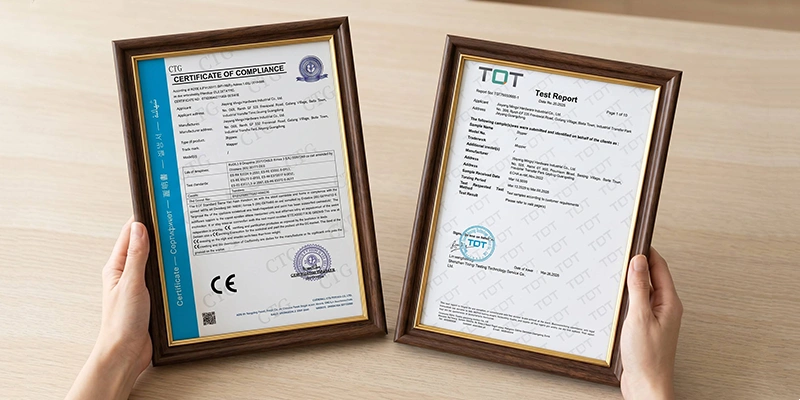
The good news: our standard product line has already passed CA65 (US), EU REACH, and EU RoHS certification. We hold both GCC (for adult slippers) and CPC (for children’s slippers, US sizes 9C and above) and can provide documentation before you place an order. But depending on your target market and product category, there may be additional requirements on your side of the transaction. This guide tells you what those are.
One thing to understand upfront: compliance is not just a paperwork exercise. Missing a required certificate does not mean a delayed shipment or a difficult conversation with your buyer. In the US, it can mean your goods are detained at customs and your company is subject to CPSC fines before a single pair reaches your warehouse. The stakes are higher than most first-time importers expect.
At a Glance: Certifications by Market
| Market | Key Certifications | Who Is Responsible | We Already Have |
|---|---|---|---|
| USA | GCC (adult) · CPC (children’s) · CA65 · CPSC eFiling | Factory issues · Buyer files | GCC · CPC · CA65 |
| EU | REACH · RoHS · CE (if applicable) | Factory | REACH · RoHS |
| UK | CE marking still valid (UKCA transition indefinitely postponed) | Same as EU | EU compliance sufficient |
| Australia | ACCC labeling · AS/NZS (if applicable) | Buyer | Labeling support |
| Korea | KC certification (children’s) | Buyer arranges testing | Testing coordination |
US Market
The United States has the most operationally consequential slipper import certifications of any major market. “Consequential” because for core certifications like GCC and CPC, the enforcement mechanism is not a fine at the retail level — it is detention at the port of entry. eFiling enforcement, by contrast, is currently operating with a softer posture (see below).
What Is a GCC and Why Does Every Adult Slipper Shipment Need One?
A General Conformity Certificate (GCC) is a document — issued by the manufacturer — declaring that the product meets all applicable CPSC safety rules[^1]. For adult slippers, this covers flammability standards, restricted substance limits, and labeling requirements. We issue a GCC for every adult slipper order we ship to the US. It is part of our standard documentation package, not an add-on.
What buyers sometimes do not realize: the GCC requirement applies to the specific product and production run. If you reorder with a different material or updated design, the previous GCC does not carry over. A new production run requires a new declaration.
What Is a CPC and Which Slipper Sizes Require It?
A Children’s Product Certificate (CPC) is a stricter version of the GCC — required for any product designed or marketed for children 12 years and under, and it must be based on testing by a CPSC-accredited third-party laboratory. Unlike the GCC, a manufacturer cannot self-declare a CPC. The lab test is mandatory.
Our size range covers US sizes 9C and above, which includes sizes worn by children under 12. All children’s sizes in our line have CPC documentation backed by third-party lab testing.
A buyer came to us after an experience with a previous supplier that still costs him when he talks about it. A shipment of children’s slippers — no CPC — was detained at the Port of Los Angeles. The goods sat in a bonded warehouse while the compliance issue was resolved. By the time the paperwork cleared, the storage fees, customs broker charges, and rush re-testing costs had added up to more than three times what he had “saved” by not asking about certifications upfront. His first question when he contacted us: “Can you show me your CPC?”
The answer was yes. It always should be.
What Is California Proposition 65 (CA65)?
Prop 65 requires businesses to provide warnings before knowingly exposing anyone to chemicals on California’s restricted substance list — which includes lead, phthalates, and certain azo dyes commonly found in footwear materials. Our standard EVA and PVC formulations have been tested against the Prop 65 list. We hold CA65 certification and can provide the test report on request.
If you are selling into California specifically — through retail chains, e-commerce, or wholesale — this is not optional.
CPSC eFiling — Live as of July 8, 2026, but With a Soft Start
CPSC eFiling went live on July 8, 2026, requiring electronic submission of certificate data for certain product categories including slippers under HTS code 6405909000. However, per CPSC’s own guidance issued the same day (CBP CSMS #69177694), missing PGA Message Set data will not result in CBP rejecting or detaining shipments at this stage. CPSC has chosen not to implement hard-block enforcement — meaning your customs broker can submit the entry even without the eFiling data, and goods will still clear.
What this means in practice: The eFiling system is live and compliance is expected, but the current enforcement posture is lenient. This can change without much notice. The underlying GCC and CPC obligations remain fully in force regardless — a soft enforcement window on eFiling does not change the requirement to hold valid certification documents.
Verify current enforcement status with your customs broker before each shipment. CPSC enforcement posture is subject to change.
EU Market
What EU Regulations Apply to Imported Slippers?
The EU framework for slippers is built primarily around chemical substance restrictions rather than product-specific safety standards. The two that apply to virtually every slipper import are REACH and RoHS.
REACH (Registration, Evaluation, Authorisation and Restriction of Chemicals) restricts the use of Substances of Very High Concern (SVHCs) in products sold in the EU. The current REACH SVHC list currently covers 251 substances (as of November 2025) including certain phthalates in PVC components, azo dyes, nickel in metal embellishments, and chromium VI in leather. Our standard line has been tested against the current REACH SVHC list. We update testing when the list is revised — which ECHA does twice per year.
RoHS applies only if your slipper contains electronic components — LED lighting, heating elements, or embedded sensors. Standard EVA and PVC slippers are not affected. If you are sourcing light-up or heated slippers, this changes.
Do Slippers Need CE Marking in Europe?
For standard adult and children’s slippers used as everyday indoor or outdoor footwear — no. CE marking is not required. It becomes relevant only if the product is classified as Personal Protective Equipment (PPE), which applies to work safety footwear, not consumer slippers[^2].
The exception to watch: if your product makes any claim related to therapeutic benefit, orthopedic support, or medical use, it may be reclassified under a different regulatory category with stricter requirements. Avoid medical-adjacent language in your product listings unless you have the supporting documentation.
What Is the EU Digital Product Passport and Should I Care About It Now?
The EU’s Ecodesign for Sustainable Products Regulation (ESPR) will introduce Digital Product Passports (DPP) for footwear starting in 2026. This will require manufacturers to document and disclose material composition, recycled content, repairability, and end-of-life information in a standardized digital format.
This is not imminent for slippers, but it is coming. The ESPR regulation entered into force in July 2024. Delegated acts specifically covering footwear are expected between 2026 and 2027, with mandatory requirements likely applying from 2027–2028 onward. Buyers building long-term EU private label lines should be aware of this direction — we are tracking the requirement and can discuss our current material transparency capabilities on request.
What About the UK Market After Brexit?
Good news for buyers selling into both the EU and UK: you do not need separate certification. Following Brexit, the UK introduced the UKCA mark as a proposed CE replacement — but under the Product Safety and Metrology (Amendment) Regulations 2024, the UK government has indefinitely extended CE marking recognition for the Great Britain market[^3]. CE marking remains fully valid for slippers exported to England, Scotland, and Wales. If you already hold EU REACH compliance documentation, no additional UK-specific certification is currently required.
Note: Northern Ireland follows different rules under the Windsor Framework and continues to align with EU product regulations. Confirm specifics with your importer of record.
Australia & Korea

Australia
The Australian Competition and Consumer Commission (ACCC) enforces mandatory product safety standards and labeling requirements. For standard adult slippers, the primary requirement is accurate labeling: country of origin, importer information, and material composition. No product-specific certification is required for general consumer slippers.
For children’s slippers, Australia’s Consumer Product Safety Standards apply — specifically around drawstring and cord hazards on children’s footwear. We manufacture without drawstrings or cords on children’s styles as standard practice.
Korea
Korea’s KC (Korea Certification) mark is required for certain product categories — children’s slippers fall within scope. The KC certification process requires testing by a Korea-accredited laboratory, which is typically arranged by the importer or buyer rather than the overseas manufacturer.
If you are entering the Korean market with children’s styles, build KC testing into your pre-launch timeline — the process typically takes 4–6 weeks and needs to be completed before goods can legally be sold.
Who Is Actually Responsible for What?
The factory’s responsibility:
- Material compliance with destination market substance restrictions
- Issuing GCC (adult, US market)
- Providing CPC backed by accredited lab testing (children’s, US market)
- Third-party test reports (REACH, CA65, RoHS where applicable)
- Accurate country of origin and material labeling on product and packaging
The buyer’s responsibility:
- Registering as importer of record
- Ensuring correct HS code classification
- CPSC eFiling (US)
- Arranging KC testing (Korea)
- UK Authorized Representative (UK market)
- Retail channel-specific requirements (some retail chains impose their own testing requirements beyond regulatory minimums)
The most common misconception: a test report from the factory means you are covered. It does not. Test reports confirm the materials at the time of testing. If the factory changes a material — even a minor formulation adjustment — the previous report may no longer be valid. Ask your factory to notify you of any material changes between orders. We do this as standard practice.
Q&A
Can you provide test reports and certificates before I place an order?
Yes. We can share existing GCC, CPC, CA65, REACH, and RoHS documentation before order confirmation. For buyers evaluating us as a new supplier, we treat this as a standard part of the qualification process — not something you need to push for.
What if I am selling in a market not covered here?
Tell us your target market in your inquiry. We will advise on what we currently have, what additional testing may be required, and what a realistic timeline looks like. Markets we regularly export to beyond the above include France, Germany, Australia, Japan, and the UAE — each with their own nuances.
Do adult and children’s slippers require different certifications?
Yes — significantly so in the US market. Adult slippers require a GCC; children’s slippers (12 and under) require a CPC from an accredited third-party lab. In most other markets, children’s products face additional scrutiny on chemical substances and mechanical safety. Always specify whether your order includes children’s sizes so we can confirm the correct documentation set.
How often do slipper import certifications and compliance requirements change?
More frequently than most buyers expect. The EU REACH SVHC list is updated twice per year. US CPSC issues guidance updates on an ongoing basis. California adds substances to the Prop 65 list annually. This is one reason to work with a factory that actively tracks these changes — rather than relying on a test report that may have been accurate 18 months ago but has not been reviewed since.
Ready to Confirm Your Market Requirements?
The compliance landscape is more complex than it was five years ago and is moving in one direction — toward more requirements, not fewer. Buyers who get ahead of this have a structural advantage: they can enter new retail channels faster, avoid port delays, and present documentation to their buyers without scrambling.
We hold GCC, CPC, CA65, EU REACH, and RoHS documentation as standard. If your market requires something beyond this, tell us upfront and we will confirm what the pathway looks like.
- Visit mappershoe.com — browse our product range and OEM capability.
- Send your inquiry — include your target market and whether your order includes children’s sizes. We respond within 1 business day.
- Request our compliance documentation — we will send the relevant certificates before you commit to anything.
Follow us on Instagram · TikTok · YouTube to see our production floor and quality process firsthand.
About the Author
I’m James, a Product Manager at Mapper Footwear — an integrated manufacturer and trading company in Xianqiao, Jieyang. 2,000 sqm facility · 60+ staff · 10,000 pairs/day capacity. Products span EVA slippers, PVC flip-flops, warm slippers, and garden shoes — certified to CA65, EU REACH, and RoHS. GCC and CPC available for US-bound shipments. Six years managing wholesale export for buyers across Europe, North America, and Korea.
Follow Mapper Footwear:
Instagram · TikTok · YouTube · Facebook · WhatsApp +86 183 1221 8218 · mappershoe.com
[^1]: “General Certificate of Conformity”, https://www.cpsc.gov/Business–Manufacturing/Testing-Certification/General-Certificate-of-Conformity. Under Section 14(a) of the Consumer Product Safety Act and 16 CFR Part 1110, manufacturers and private labelers of non-children’s consumer products must certify, based on testing, that their products comply with all applicable consumer product safety rules (U.S. Consumer Product Safety Commission, ‘General Certificate of Conformity’).
[^2]: “EU – Labeling/Marking Requirements”, https://www.trade.gov/country-commercial-guides/eu-labelingmarking-requirements. Regulation (EU) 2016/425 on Personal Protective Equipment requires CE marking for products designed and manufactured to be worn for protection against health or safety risks; general consumer footwear without protective claims falls outside the scope of this regulation and does not require CE marking (European Commission, ‘Personal Protective Equipment’).
[^3]: “United Kingdom Extends CE Mark Recognition”, https://www.trade.gov/market-intelligence/united-kingdom-extends-ce-mark-recognition. The Product Safety and Metrology etc. (Amendment) Regulations 2024 (SI 2024/No. 1066) removed the previously set deadline for the transition from CE to UKCA marking, allowing CE-marked products to continue to be placed on the Great Britain market indefinitely (UK Government, Department for Business and Trade).