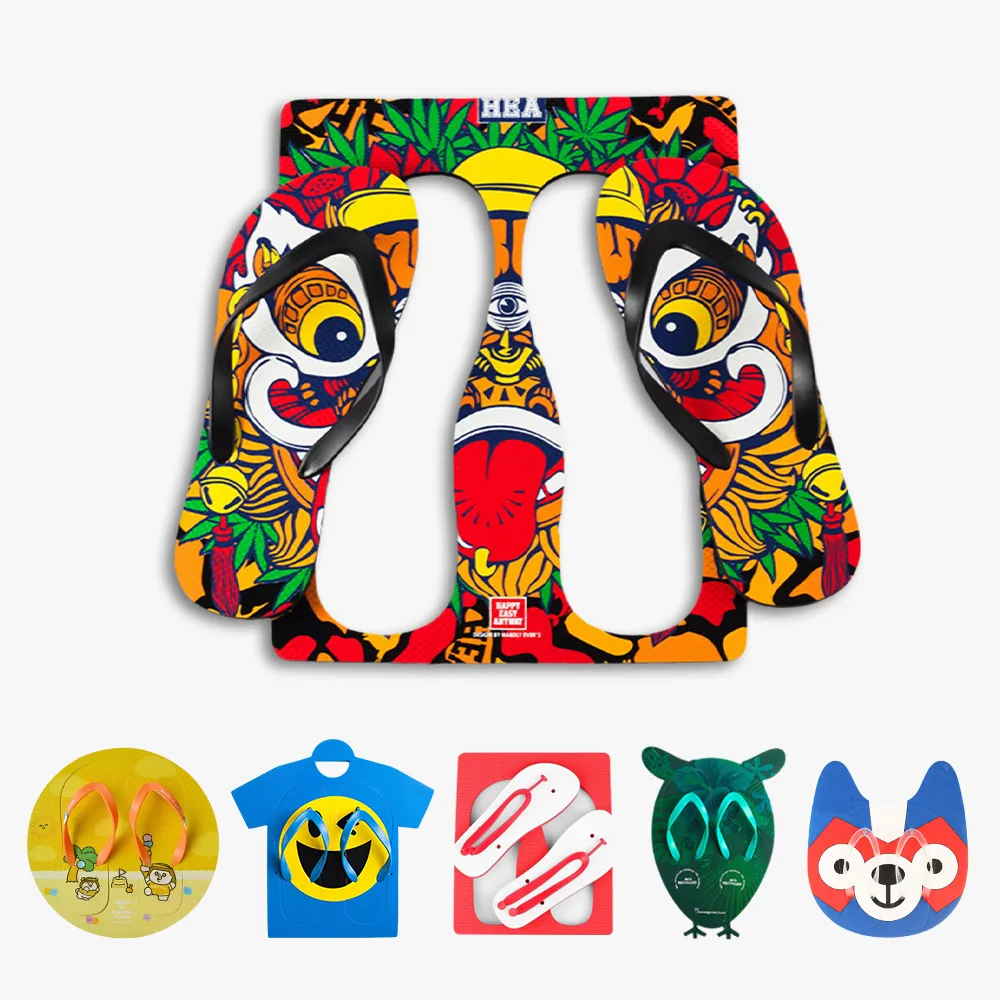
Ordering, Pricing & Customization — Step by Step
By James, Product Manager, Mapper Footwear — Jieyang, Guangdong | mappershoe.com
Last updated: July 2026
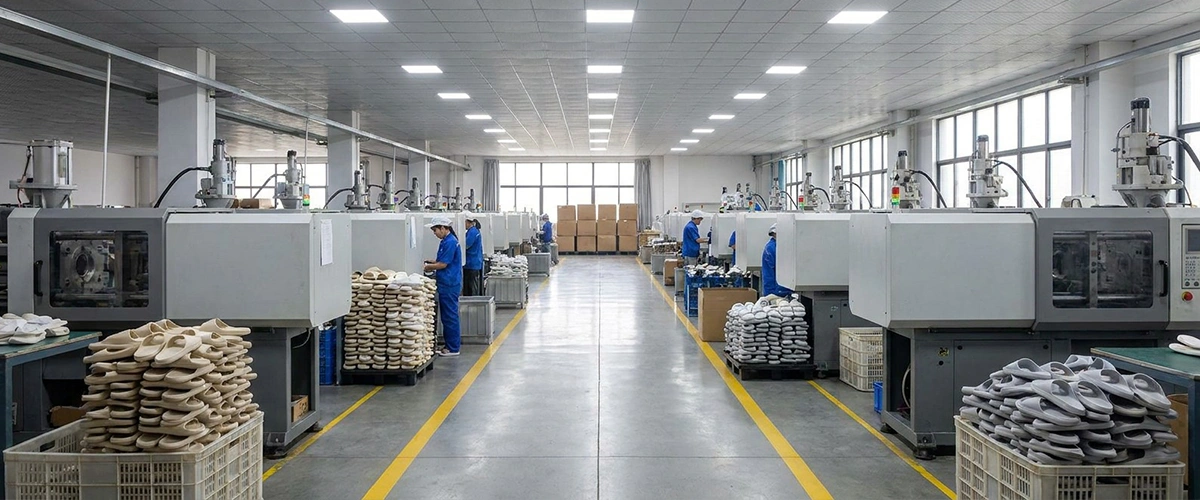
Here is the short answer: contacting a slipper factory in China triggers a seven-step sequence — inquiry, quote, sample, order confirmation, production, inspection, container — that typically runs 60 to 75 days from first email to goods at port.
The sequence itself is not the hard part. Most sourcing problems do not happen because buyers followed the wrong steps — they happen because buyers treated certain steps as formalities. A sample approval done over a video call. A payment term agreed in a chat message. A landed cost estimate that only counted the FOB price. None of these feel like major decisions at the time. All of them have a predictable cost when they go wrong.
This guide covers all seven steps. Each one answers three questions at once: what to do, what it costs, and how the process differs depending on whether you are buying standard styles, adding your branding, or developing a custom product from scratch. If you only have a few minutes, the overview table below and the Q&A section near the end cover the essentials. If you are preparing for an actual order, the full breakdown will save you at least one avoidable mistake.
Which Path Are You On?
Three sourcing paths, meaningfully different in cost, timeline, and process. Pick yours before reading further.
| Standard | Light Custom | Full Custom OEM | |
|---|---|---|---|
| MOQ | 20 pairs/style | 20 pairs/style | 500–5,000 pairs/style |
| Sample | Free (freight only) · 3–5 days | $40–60 · 5–7 days | Mold fee + $9–20 · 20–30 days |
| Production | 3–5 days | 5–7 days | 45–60 days |
| Mold Cost | None | None | PVC $450–750 / EVA $1,700–1,950 per size |
| Best For | Trial orders, fast restock | Private label, color/logo change | Exclusive design, high volume |
STEP 1 — The First Inquiry
The quality of a factory’s response is almost entirely determined by the quality of the inquiry they receive. “I need slippers, what is your price?” gets a catalog and a price range wide enough to be meaningless.
The inquiry is a filter. It determines whether a factory takes you seriously or files you in the low-priority pile.
What Should I Include in My First Email to a Slipper Factory?
Factories receive dozens of inquiries a week. The ones that get fast, detailed responses share eight things in common — not because factories are being selective, but because without this information, a useful quote is genuinely impossible to produce:
- Product type and intended use (indoor slipper, beach flip-flop, garden clogs, etc.)
- Target quantity and size breakdown (e.g. 500 pairs, EU 36-48, equal ratio)
- Material preference or reference (EVA, PVC — or open to suggestion)
- Customization requirement: none / logo only / full custom
- Target FOB price range if known
- Destination market (EU, US, AU — compliance requirements differ)
- Required ship date or window
- Whether you need samples first or are ready to discuss bulk directly
Template: “We are a [retailer/brand/importer] in [country]. Looking for
for [use]. Qty: [XXX] pairs, sizes [XX–XX]. Material: [PVC/EVA/open]. Custom: [none/logo/full OEM]. Target FOB: [USD X.XX]. Market: [EU/US/other]. Ship by: [date]. Sample first: [yes/no].”
STEP 2 — Reading the Quote
A factory quote is not just a price per pair. It is a compressed record of every cost decision the factory made. The number on the page tells you what the factory is charging — it does not tell you what they cut to get there.
Why Do Two Slipper Quotes Look the Same but Price Differently?
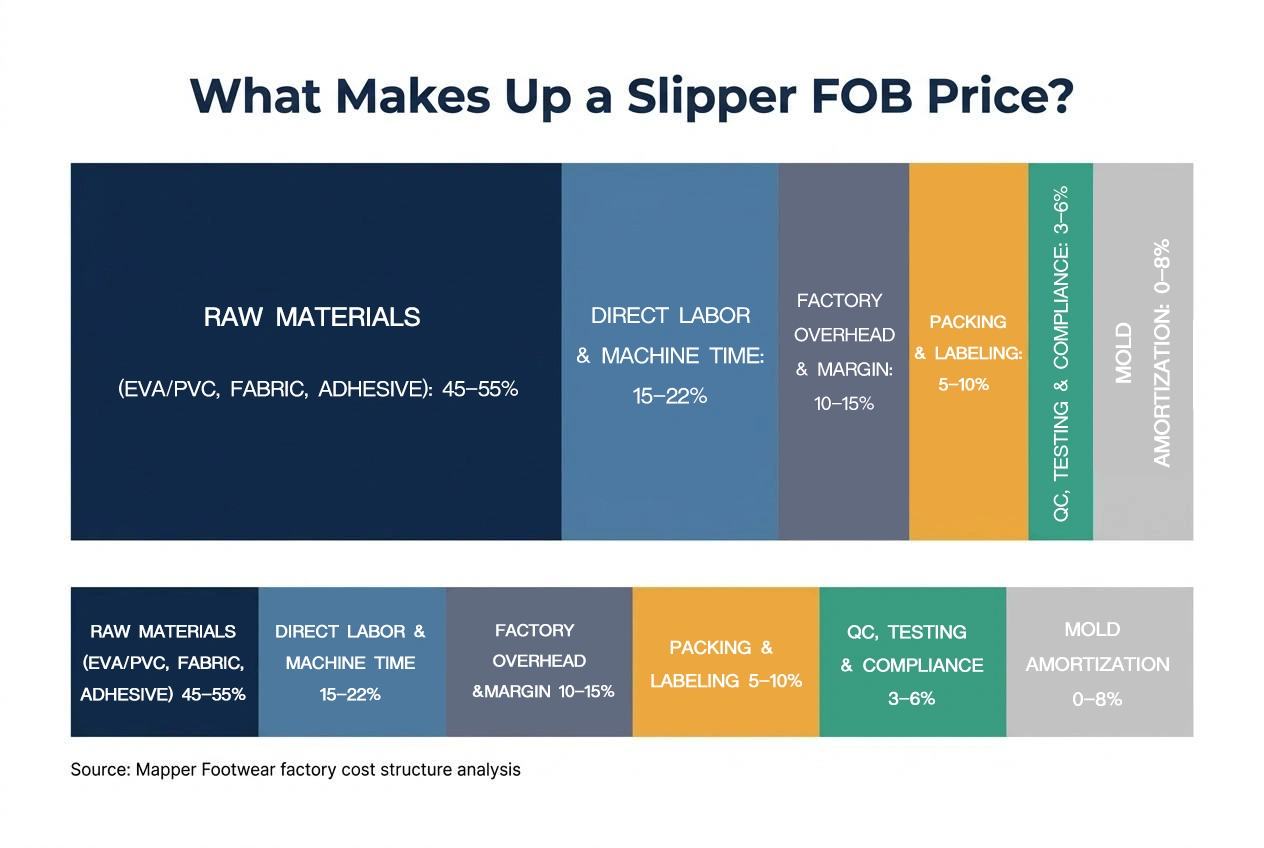
Every FOB slipper price is built from six cost components. When a quote comes in 15-20% below others, it does not mean that factory is more efficient. It means something in this structure has been compressed. The question worth asking is not “how low can you go” — it is “which line did you adjust to get there.”
| Cost Component | % of FOB | Main Variable | Your Lever |
|---|---|---|---|
| Raw materials (EVA/PVC compound, fabric, adhesive) | 45-55% | Compound grade, density spec | Material spec negotiation |
| Direct labor & machine time | 15-22% | Style complexity, run length | Order volume |
| Mold amortization | 0-8% | New vs. repeat style | Reorder frequency |
| QC, testing & compliance | 3-6% | Destination market | Market choice |
| Packaging & labeling | 5-10% | Standard vs. custom box | Packaging spec |
| Factory overhead & margin | 10-15% | Scale & utilization | Relationship & volume |
Quote 20%+ below market? One of these was cut: material grade · subcontracted labor · skipped compliance testing · squeezed margin. Ask for a material spec sheet before committing.
What Is the Real Cost of Importing Slippers from China?
FOB is where negotiation happens. Landed cost is what you actually pay. Most first-time importers don’t budget for the gap — and it is larger than expected.
Landed Cost = FOB total + Ocean freight + Port charges + Import duty + Customs clearance
Example: 5,000 pairs EVA slippers to the US (FCL 20ft):
FOB ~$16,000 · Freight ~$1,800–2,500 · Duty 9–37.5% of FOB[^1] · Clearance ~$300–500
→ Landed cost per pair: ~$3.80–4.60Tariff rates are subject to change. Verify with your customs broker before finalizing budgets.
STEP 3 — Samples
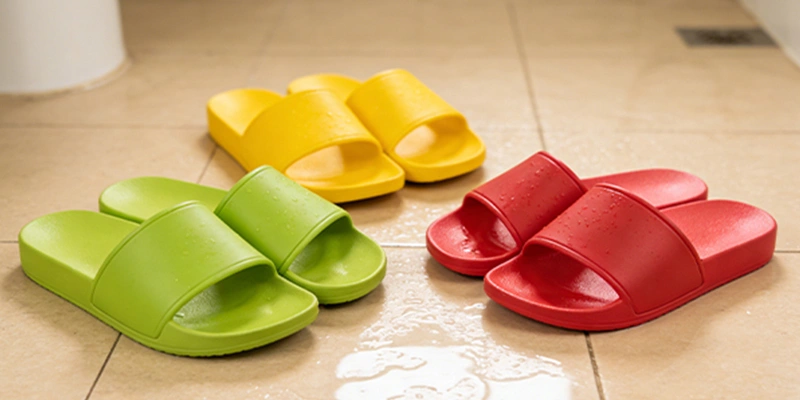
The sample stage is the only point in the entire process where you can hold the product in your hands before committing to a production run. Every step before it is negotiation. Every step after it is execution. This is the one moment where changing your mind costs almost nothing.
Most buyers treat it as a checkpoint. It should be treated as an audit.
Do Chinese Slipper Factories Charge for Samples?
It depends on the order type. For standard styles with no changes, we ship samples free — the buyer covers freight only. For light custom orders involving color or logo changes, there is a sample development fee. For full custom OEM with new tooling, both a mold fee and a sample fee apply.
| Standard | Light Custom | Full Custom OEM | |
|---|---|---|---|
| Sample Fee | Free (freight only) | 100% deducted from bulk | Sample fee deductible, mold fee not |
| Mold Cost | None | Plate making fee $40–60/style | PVC $450–750 EVA $1,700–1,950 /per size · buyer-owned |
| Lead Time | 3–5 days | 5–7 days | 20–30 days |
How Do I Know If a Slipper Sample Is Good Enough to Approve?
I have encountered many similar cases before: a buyer from the UK approved a light custom sample through the images in the Alibaba chat interface — they held it up to the camera, liked the color, and gave the go-ahead. The bulk order arrived with the logo shifted 4mm to the left on every single pair. Not enough to fail inspection on technical grounds, but enough that the buyer’s retail customer rejected the shipment on aesthetic grounds. The fix required a markdown sale and a delayed reorder. A five-minute physical check against a written spec would have caught it.
This is where most buyers are too lenient. Approving a sample that is “close enough” creates the assumption that “close enough” is acceptable in bulk. Run through this checklist on every physical sample before you sign off:
- [x] Dimensions vs. spec (tolerance ±3mm) · Weight (deviation = material substitution)
- [x] Color vs. Pantone under D65 lighting[^2] — not office fluorescent
- [x] Strap pull test: apply approximately 20kg tensile force — no delamination, tearing, or strap separation. Sole grip: wet-surface test if applicable
- [x] Logo/print: edges sharp, misalignment within 1mm · Colorfastness: no transfer on damp cloth
- [x] Packaging labels: origin, material content, size marking — all accurate
STEP 4 — Confirming the Order
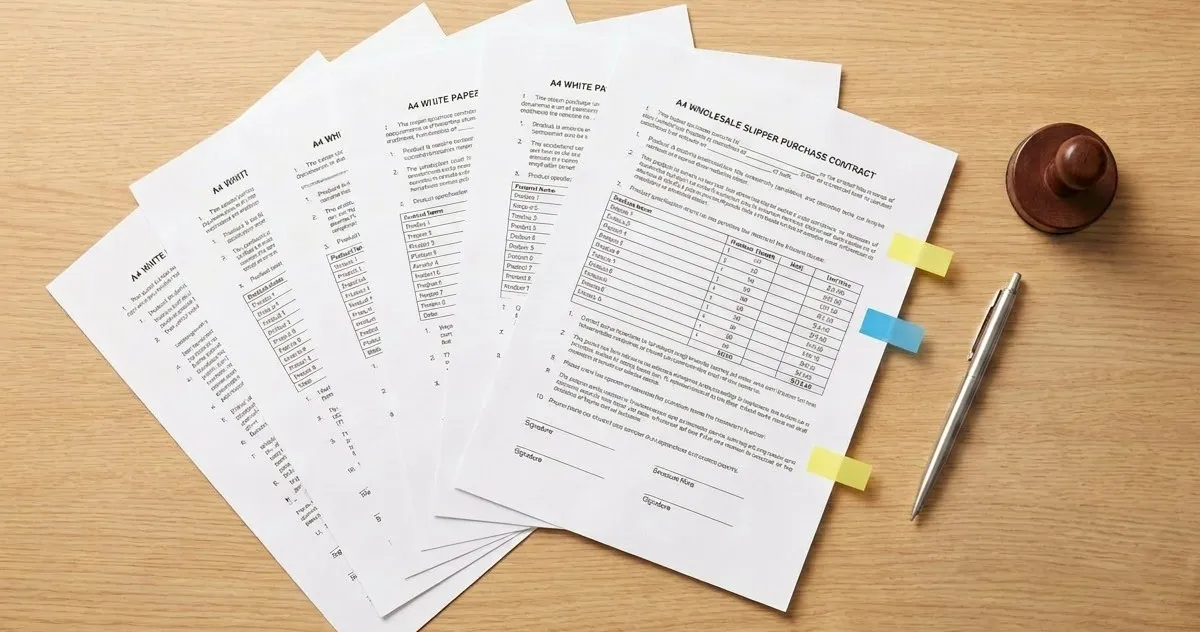
Most sourcing disputes are not caused by bad factories. They are caused by agreements that were never written down clearly enough to be enforced. A price discussed over WeChat, a delivery date buried in an email thread, a quality standard that both sides thought they understood differently — these are the conditions that turn a workable problem into an expensive argument.
The paperwork at this stage is not bureaucracy. It is the difference between a dispute that gets resolved in a day and one that takes three months.
What Documents Do I Need Before a Factory Starts Production?
Two documents are non-negotiable: a pro forma invoice from the factory and a purchase order from you. Your PO must cover: product name + style number + material spec · size breakdown and quantity · unit price (FOB Jieyang or agreed Incoterms) · customization details (Pantone, logo file, packaging) · payment terms · ship date · approved sample reference · pre-shipment inspection right.
Is 30/70 Payment the Standard When Ordering from China?
For a first order with a factory you have not worked with before, yes — 30% deposit on order confirmation, 70% before shipment is the industry norm[^3]. It protects both sides: the factory has confirmation you are serious before committing materials, and you retain leverage over the balance until inspection clears.
After a few successful orders, terms tend to shift. That conversation is worth having once you have a track record — not on the first order.
Full Custom OEM: Sign a mold development agreement before production — covering specs, timeline, ownership (buyer-owned, confirm in writing), and storage terms (typically free for 2–3 years).
STEP 5 — Production
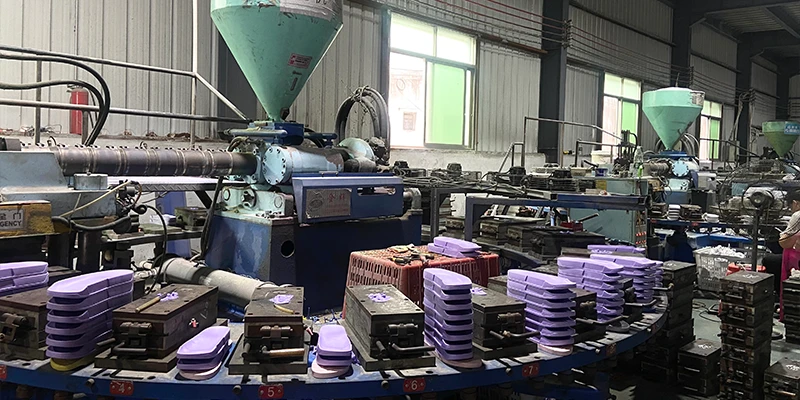
Deposit cleared, PO confirmed — production is scheduled. From this point, here is what is happening inside the factory and what you should be paying attention to from the outside.
Our facility: 2,000 sqm in Xianqiao, Jieyang · 60+ staff · 40+ machines (injection molding, UV, high-frequency) · 10,000 pairs/day capacity. That last number matters to you because it determines whether your order fits into the schedule without pushing your delivery date.
How Long Does It Take to Manufacture Slippers in China?
Production time varies by order type and season. The table below covers normal conditions. Add 7-10 days during Q3 and the pre-Chinese New Year window — factory capacity runs tight in both periods and buyers who lock in slots early consistently get better delivery performance.
| Order Type | Normal Season | Peak Season (Q3 / Pre-CNY) |
|---|---|---|
| Standard | 3-5 days | 10-15 days |
| Light Custom | 5-7 days | 12-17 days |
| Full Custom OEM | 45-60 days | 52-70 days |
When Does It Actually Make Sense to Open a Custom Mold?
Mold tooling is a capital commitment. Before you commit: annual volume above 2,000 pairs? At least 2–3 reorder cycles planned? Does the design give you a position competitors can’t easily match? If the answer to any of these is uncertain, start with an existing style. EVA molds are buyer-owned and stay yours permanently — but low-volume exclusivity is expensive exclusivity.
How Much Cheaper Does It Get If I Order More?
The curve is not linear. The biggest drop happens between MOQ and roughly 3x MOQ. Beyond 5,000 pairs, savings shift from unit price to logistics efficiency.
MOQ (20–50 pairs): base price · 200–500 pairs: –8–12% · 1,000–2,000 pairs: –15–20% · 5,000+ pairs: –20–28%
STEP 6 — Quality Inspection
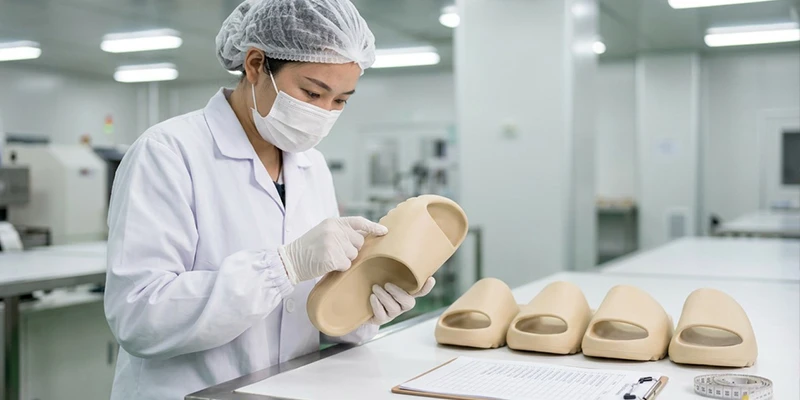
Pre-shipment inspection is the step most first-time buyers skip and most experienced buyers treat as non-negotiable. Once the balance clears and the container is sealed, your ability to address problems drops to near zero.
Can I Send My Own Inspector to a Chinese Slipper Factory?
Yes — and we encourage it. Third-party inspectors are welcome on-site. If you cannot arrange an inspector, we provide photo and video documentation of the production batch and loading process as standard practice on every shipment.
| Option | What It Covers | When to Use |
|---|---|---|
| Factory QC team | Internal defect check, basic dimensions and appearance | Standard reorders with established supplier |
| Buyer’s own inspector | On-site visit, full AQL sampling, photo/video report | Preferred for large orders or first production run |
| Third-party agency (SGS, BV, Intertek) | Independent AQL, compliance testing, official report | EU/US regulated markets, high-value orders, new supplier |
What Do Inspectors Actually Check on a Slipper Shipment?
We assign dedicated QC staff at every stage — molding, assembly, packaging, loading. Non-conforming units are pulled on the floor, not at the end of the line. Pre-shipment inspection is still the independent final check — it confirms the full batch, not just in-line samples.
A standard AQL inspection covers: dimensional accuracy, logo/print position and color match, EVA density and surface consistency, packaging label accuracy, and quantity count against PO.
STEP 7 — Final Payment, Booking & Container Loading
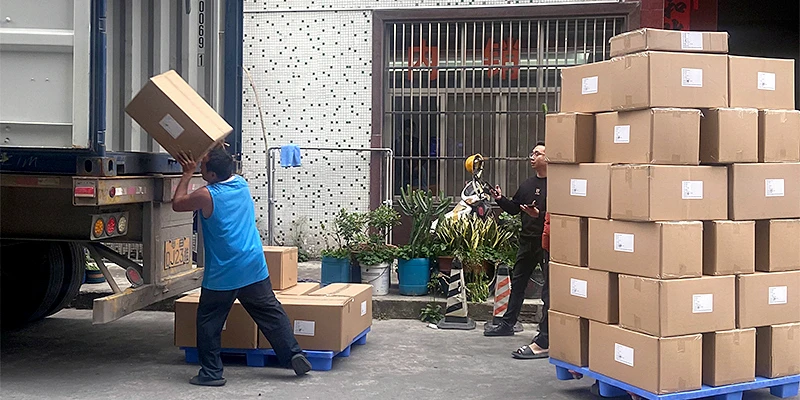
Inspection passed, balance released — the shipment is booked. This is the last operational stage before the goods leave Jieyang.
Should I Use LCL or FCL to Ship My Slipper Order?
The decision comes down to volume. LCL (Less than Container Load) makes sense for smaller orders — you share container space and pay per cubic meter. FCL (Full Container Load) becomes more cost-effective once your volume fills a 20ft container.
| LCL | FCL | |
|---|---|---|
| Use when | Below 5,000 pairs (EVA) / 12,000 pairs (PVC) | Above those thresholds |
| Cost | Per CBM — flexible | Fixed rate — cheaper at scale |
| Risk | More handling touchpoints | Dedicated container, lower damage risk |
What Shipping Documents Does a Factory Send After Loading?
Standard set: Bill of Lading (B/L) · Commercial Invoice · Packing List · Certificate of Origin · Test reports (if arranged) · Loading photos and container seal number. We provide the last two as standard on every shipment.
What Costs Am I Responsible for After the FOB Price?
Everything after the port of origin: ocean freight · marine insurance (0.1–0.3% of cargo value) · destination port charges · import duty and VAT/GST · customs clearance fee · inland delivery. First-time importers consistently underestimate this total — budget it before you negotiate FOB.
Q&A — The Questions Buyers Ask Before They Commit
What is the minimum order quantity for wholesale slippers from China?
Standard and light custom: 20 pairs per style. Full custom OEM: 500 pairs minimum. If you are testing a new market, start with a standard order — the process is identical whether you order 20 pairs or 2,000.
Will my sample fee be deducted when I place the bulk order?
Light custom: yes, 100% deducted from your first bulk invoice. Full custom OEM: the sample fee is deductible, the mold cost is not. The mold is a permanent capital asset — it stays yours, it does not get amortized.
How fast can I get slippers shipped if my deadline is tight?
Standard styles: 3–5 days production, express courier available for small quantities. Light custom: 5–7 days. Full custom OEM: mold development alone takes 20–30 days — no shortcut exists. Tell us your deadline at the inquiry stage and we will give you a straight answer, not a qualified maybe.
Can I visit the factory before I place an order?
Yes. Factory visits are welcome — particularly for buyers planning a full OEM program. We are in Xianqiao, Jieyang. Contact us ahead of time and we will coordinate around the production schedule.
What compliance documents can you provide for EU and US markets?
Our standard line has passed CA65, EU REACH, and EU RoHS certification. SGS, BV, or Intertek test reports are available on request. For additional certifications, raise the requirement before sampling so we can confirm material compatibility upfront.
Ready to Start? Here Is What to Do Next.
Seven steps, 60–75 days, one contact from day one. The process is straightforward when you know what to expect. The mistakes happen when buyers skip steps or work with suppliers who disappear after the deposit clears.
- Browse mappershoe.com — full products, specs, OEM capability.
- Send your inquiry using the eight-point framework from Step 1. Response within 1 business day.
- Request samples — standard styles free (freight only). Light custom: $40–60.
The first conversation costs nothing.
Follow us on Instagram, TikTok, and YouTube to see our production floor, materials, and finished products before you reach out. For urgent inquiries, WhatsApp us directly at +86 183 1221 8218.
About the Author
Jame is a Product Manager at Mapper Footwear, an integrated manufacturer and trading company in Xianqiao, Jieyang. 2,000 sqm facility · 60+ staff · 10,000 pairs/day capacity · 40+ specialist machines. Products span EVA slippers, PVC flip-flops, warm slippers, and garden shoes — all CA65, EU REACH, and RoHS certified. Six years managing wholesale export for buyers across Europe, North America, and Korea.
Follow Mapper Footwear:
Instagram · TikTok · YouTube · Facebook · WhatsApp +86 183 1221 8218 · mappershoe.com
[^1]: “Harmonized Tariff Schedule – United States International Trade …”, https://hts.usitc.gov/. The US Harmonized Tariff Schedule, Chapter 64, assigns duty rates for footwear with rubber or plastic outer soles ranging from free to 37.5% ad valorem, with specific rates depending on material composition, upper coverage, and value per pair (USITC HTS, Chapter 64).
[^2]: “Standard illuminant – Wikipedia”, https://en.wikipedia.org/wiki/Standard_illuminant. CIE Standard Illuminant D65 represents a phase of natural daylight with a correlated color temperature of approximately 6504K and is specified in ISO 3664:2009 and ISO 3668:2017 as the standard viewing condition for color matching and quality assessment in manufacturing.
[^3]: “China – Methods of Payment | export.gov”, https://legacy.export.gov/article?id=China-Methods-of-Payment. Trade facilitation resources and China sourcing advisories consistently identify 30% T/T deposit with 70% balance against copy of B/L or before shipment as the predominant payment structure for initial orders between international buyers and Chinese manufacturers.