By Jame, Product Manager, Mapper Footwear | Last updated: October 2026
Which Flip-Flop Logo Printing Method Fits Your Brand?
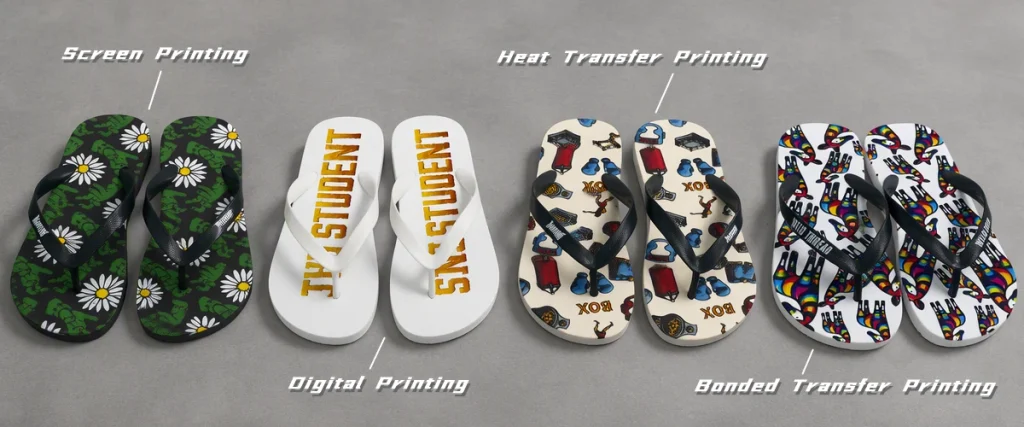
Four flip-flop logo printing methods cover almost every custom order we run: screen printing, digital printing, heat transfer, and bonded transfer. None of them is universally “best” — each trades off cost, color range, durability
against production cycle and tooling difficulty — so the right one depends on your design, your order size, and how the logo needs to perform over time. Pick based on those three factors, not on which method sounds the most advanced.
What Printing Methods Are Available for Custom Flip-Flops?
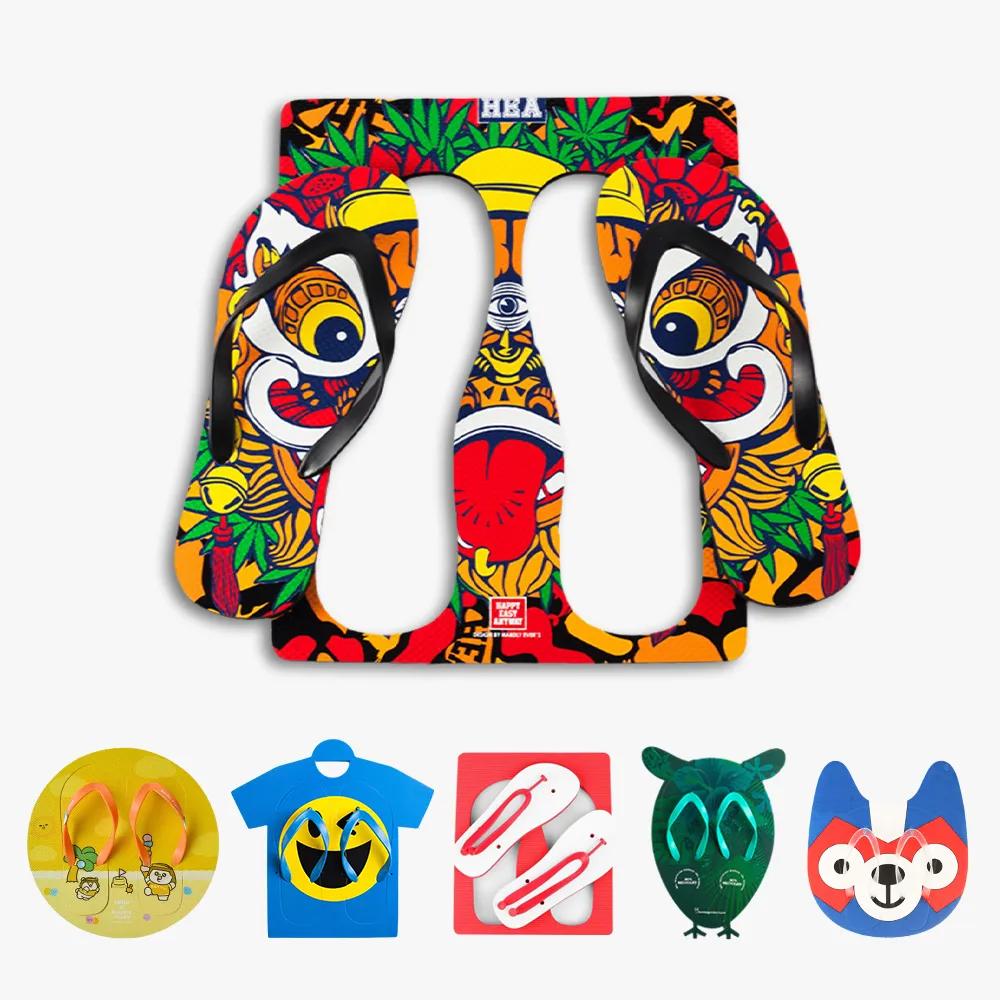
Before comparing flip-flop logo printing techniques, it helps to separate “effect” from “method.” Mapper runs four common custom effects on flip-flops: pattern printing (a repeating design across the strap or footbed), full-page printing (a single large graphic covering most of the footbed), solid color custom (base color matched to a brand palette), and hollow-out sole designs (a logo or text cut directly into the outsole). Each of these effects can be produced by more than one printing method below — the effect is what the customer sees, the method is how we get it onto an EVA or rubber surface that flexes with every step.
We’ve also covered six printing methods used across our full slipper line in a separate guide (Mingyi’s Six Slipper Printing Methods Explained); this article narrows in on the four methods that work specifically well on flip-flop straps and curved sole surfaces, where adhesion and flex-durability behave differently than on a flat slipper upper.
How Does Screen Printing Work for Flip-Flop Logos?
Screen printing applies ink through a mesh stencil, one color layer at a time, matched against a Pantone color card. The advantages are real: high color accuracy against the approved swatch, minimal color drift between production runs, and strong wear resistance once cured. The tradeoff is that screen printing works best with a limited number of spot colors — it doesn’t handle color gradients well, and running multiple colors means multiple passes, which stretches out the production cycle on complex designs.
Best fit: Screen printing suits flip-flop logo printing when the brand mark uses one to three fixed colors and the order volume is high enough that color consistency across thousands of pairs matters more than design complexity.
What’s the Difference Between Digital and Screen Printing?
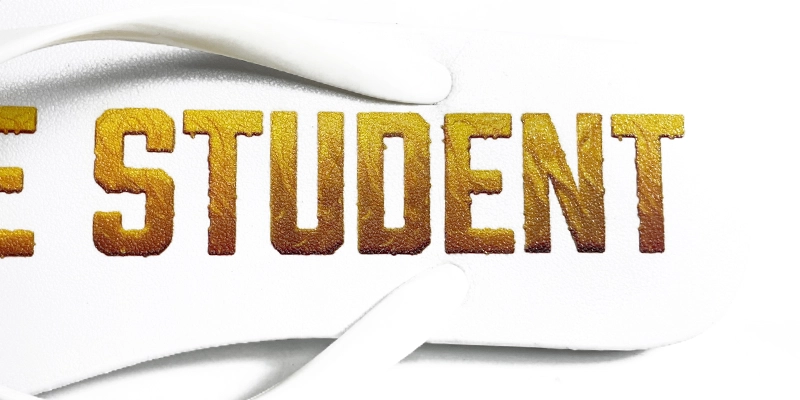
Digital flip-flop logo printing uses inkjet UV technology to print directly onto the flip-flop surface. It handles fine detail and gradient color transitions that screen printing can’t reproduce, and the color stays bright and resists fading. The cost is higher per pair than screen printing, and because it’s a different process chemistry, there’s a small chance of slight color variation between batches compared to a Pantone-matched screen print.
Best fit: Digital flip-flop logo printing works best for photo-realistic designs, gradient artwork, or multi-color graphics where screen printing’s color limits would force a design compromise.
Is Heat Transfer Printing Durable Enough for Bulk Orders?
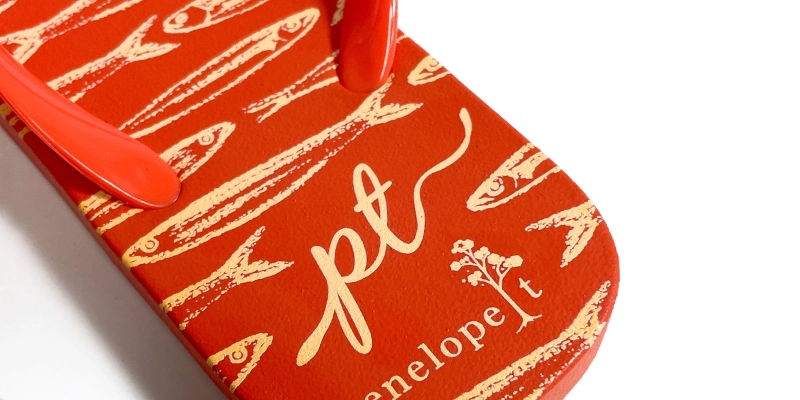
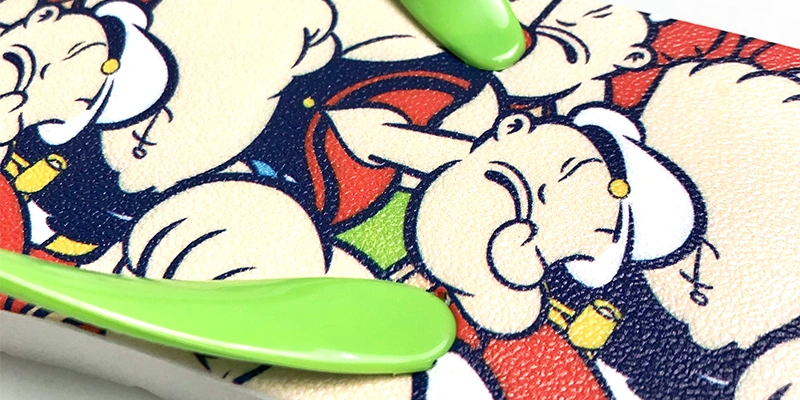
Heat transfer applies a printed film to the flip-flop surface under heat and pressure. It supports a wide color range, holds up through washing, and doesn’t leave the raised, coated feel some printing methods do — plus it’s lower cost and faster to produce than screen or digital printing. The limitation shows up on fine detail: thin lines and small text don’t transfer as cleanly as they print on screen or digital methods.
Best fit: Heat transfer flip-flop logo printing works best for budget-conscious bulk orders with simple line work or block-color logos, and for fast turnaround needs.
When Should You Choose Bonded Transfer Printing?
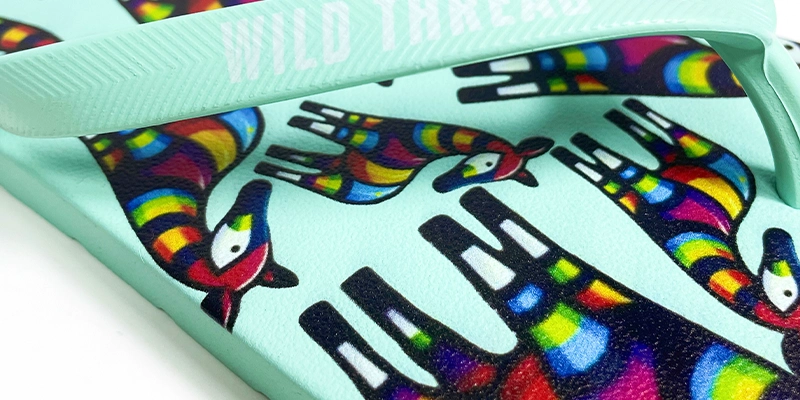
Bonded transfer flip-flop logo printing is built for flip-flops specifically because it wraps around curved surfaces — it can print across the strap and onto the surrounding footbed as one continuous image, which the other three methods can’t do on a 3D surface. The result is a clean, continuous graphic with strong overall visual impact. It’s also the most technically demanding of the four methods to execute well, which puts it at a higher cost than heat transfer or screen printing.
Best fit: Bonded transfer flip-flop logo printing fits designs that need to flow across the strap and footbed as a single graphic, and brand launches where visual impact matters more than unit cost.
Which Flip-Flop Logo Printing Method Fits Your Brand?
Here’s how the four flip-flop logo printing methods compare side by side:
| Method | Cost | Color Range | Durability | Tooling Difficulty |
|---|---|---|---|---|
| Screen Printing | Low | Limited (spot colors) | High | Low |
| Digital Printing | High | Wide (gradients) | Medium-High | Medium |
| Heat Transfer | Low | Wide | Medium | Low |
| Bonded Transfer | Medium-High | Wide | High | High |
Match the method to what the order actually needs, not to what sounds most premium. A one-color brand mark on a 5,000-pair bulk order has no reason to pay for bonded transfer; a strap-to-footbed continuous graphic has no reliable way to work with flat screen printing. If your design uses one to three solid colors and the order is large, start with screen printing. If it’s full-color or gradient artwork, look at digital printing. If budget and turnaround are the priority and the design is simple, heat transfer gets you there fastest. If the graphic needs to wrap continuously across the strap, bonded transfer is the only one of the four that does it properly.
For more on how flip-flop strap and sole materials affect how well any of these methods bond and last, see our Flip-Flop Material Guide.
Final Thoughts
There’s no single best flip-flop logo printing method — there’s only the one that fits your design complexity, your order volume, and how the logo needs to hold up over time. Tell your supplier those three things before you ask which flip-flop logo printing method they recommend, not after.
Ready to Choose a Printing Method for Your Flip-Flop Order?
Getting the printing method right on paper is one thing — seeing it on a physical sample is what actually confirms it. As a flip-flop company that runs all four methods in-house, we can match the right one to your artwork before you commit to a bulk order.
- Visit mappershoe.com — browse our wholesale flip flops catalog and see examples of each printing method in production.
- Send your inquiry with your logo design, target color count, and order quantity. We’ll recommend a printing method based on your artwork, not a generic default.
- Request samples — printed samples on your chosen method are available within 5-7 business days.
Follow us on Instagram, TikTok, and YouTube to see our production floor before you inquire.
For urgent inquiries: WhatsApp +86 183 1221 8218
About the Author: Jame is a Product Manager at Mapper Footwear, a flip-flop and slipper manufacturer based in Jieyang, Guangdong, China, with 60+ staff, 10,000 pairs/day capacity, and CA65, EU REACH, and EU RoHS certifications. Mapper supports both light customization (20-pair MOQ) and full custom OEM (500-pair MOQ) across EVA, PVC, and rubber product lines.
Follow Mapper Footwear: Instagram · TikTok · YouTube · Facebook · WhatsApp +86 183 1221 8218 · mappershoe.com
More from Jame: